
Homeowners across California’s wildfire-prone communities are increasingly confronting insurance non-renewals and higher insurance costs. In Alpine, an unincorporated portion of San Diego County community with substantial wildfire exposure, Fire Marshal Jason McBroom has built a one-on-one, case-management style approach to helping homeowners navigate insurance non-renewals, appeal decisions, and document mitigation work in ways insurers find credible. Insurance for Good sat down with the Fire Marshal to learn how his office is bridging the gap between wildfire mitigation and insurance underwriting, and what it would take for other fire departments to do the same.
Insurance for Good: How would you describe the wildfire risk profile in Alpine and how is it affecting insurance availability for residents?
Fire Marshal Jason McBroom: Alpine has about 5,238 legal parcels, of which 75% are existing single-family dwellings that were constructed prior to the wildland-urban interface codes—so they are all non-hardened homes. We sit in a very high fire hazard severity zone under the state's responsibility maps, and from an insurance fire-risk-modeling perspective, we're rated at 99.98% probability of catastrophic fire. That's causing insurers to have a lot of caution in writing insurance policies in the community.
Insurance for Good: You previously spoke with us about successes you’ve had in helping Alpine homeowners facing insurance non-renewals. What are the steps you take if a homeowner comes to the fire department with an insurance non-renewal?
Fire Marshal Jason McBroom: So step one, anytime a homeowner is coming up on renewal or receives that kind of notice, is: send me a copy of that paperwork right away, or a photo of it, so I can see what we are looking at. Is it a blanket non-renewal because the market is oversaturated and they're simply not writing policies in the area? Or is it a specific wish list with bullet items and discounts tied to line items—like California's Safer from Wildfires standard, where you complete a set number of actions to earn a discount?
Once I know what the insurance company is actually asking for, I draft a response back confirming exactly what they want the homeowner to do on their legal parcel. I want to be able to advocate for the homeowner and be able to provide a response that directly addresses the concerns from the insurance company. I also try to get in direct contact with the homeowner's broker or agent. Often it takes an actual phone call and if the paperwork is too vague, I'll ask the insurer directly, in writing, what exactly they need. Most of the time, once I respond, they backpedal and say those are just recommendations, and the conversation becomes far more workable.
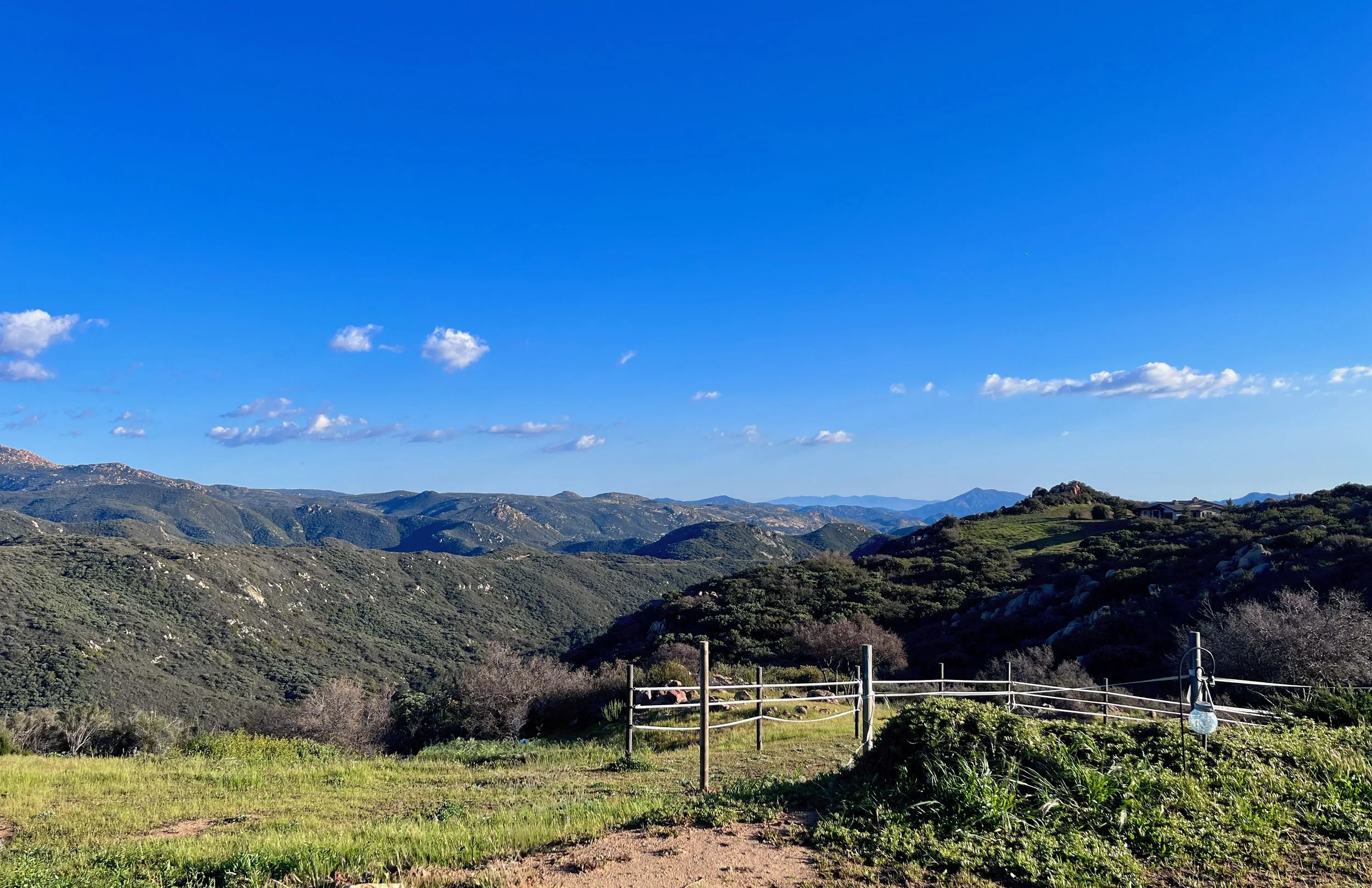
A backyard view of the Cuyamaca Mountains in Alpine, an unincorporated community in San Diego County. Photo: Sharon Smith
Insurance for Good: How do you coordinate with insurance companies or agents on inspections, risk scores, or mitigation verification?
Fire Marshal Jason McBroom: Underwriting is going to be the one that's going to do the official review and they're going to say thumbs up or thumbs down. What I wanted to do is step in and be part of that conversation. I’ve found that if data, such as travel time from the fire station, distance to the nearest hydrant, road miles, or defensible space condition, isn't entered properly by agents, their systems default to the worst case scenario and the homeowner is going to get a horrible fire score. So when that information gets transposed to underwriting, how can I be able to help educate underwriting?
Insurance for Good: What kind of evidence—photos, receipts, reports—is most persuasive to insurers?
Fire Marshal Jason McBroom: Photographs speak volumes. When I do a home ignition zone assessment, I tell homeowners: you almost want your report to fail. Show the weeds, the bad vents, the open eaves, the single-pane windows—capture that moment in time as a baseline. Then, over the following months, we document the mitigation: replacing windows with dual-pane, dual-tempered glass, swapping quarter-inch mesh screens for ember- and flame-resistant vents approved by the state fire marshal's office, maintaining defensible space, removing dead trees. That before-and-after documentation shows that the policyholder has taken a proactive stance with guidance from a certified wildfire mitigation specialist, and it gives insurers an actual cost-benefit picture instead of a subjective one. We’re just trying to provide some empowerment to the policyholder to be able to go back and work with their insurer.
“We’re just trying to provide some empowerment to the policyholder to be able to go back and work with their insurer.”
Insurance for Good: In your experience, what steps most effectively help homeowners appeal a non-renewal or seek reconsideration from insurers?
Fire Marshal Jason McBroom: If they've already received a non-renewal notice and are in that 75-day countdown window while shopping for new coverage, I give them ammo they can use to make themselves more desirable to insurers going forward. If a homeowner is newer to the area and just wants to know where they stand, I do a proactive assessment. Either way, the report belongs to the homeowner—I'll ask their consent to name their insurer so I can send documentation directly, and most companies respond very positively, calling it comprehensive and well put together.
Insurance for Good: What improvements are you seeing make the most difference to insurers? Are there lower-cost measures that improve insurability?
Fire Marshal Jason McBroom: Vent retrofits have done really well, especially in areas like ours with strong Santa Ana winds. They're also relatively low-cost. Zone Zero compliance tends to be the biggest lever, though, because insurers won't give a partial discount for partial compliance—only full compliance across all four sides of the structure earns the full discount.
Insurance for Good: What wildfire mitigation or Firewise programs are available to Alpine residents right now?
Fire Marshal Jason McBroom: Through the Alpine Firewise Fire Safe Council, we run defensible space and home hardening projects, fuel breaks, and free roadside chipping. I'm also the voting member on the Sunrise Powerlink Fire Mitigation Grant committee. Homeowners can apply for the Priority Zone Zero grant, which this calendar year provides $2,696.80 toward removing combustible material within the five-foot Zone Zero area, including replacing combustible wood fencing attached to the home or paying someone to remove trees, plants, and bushes.
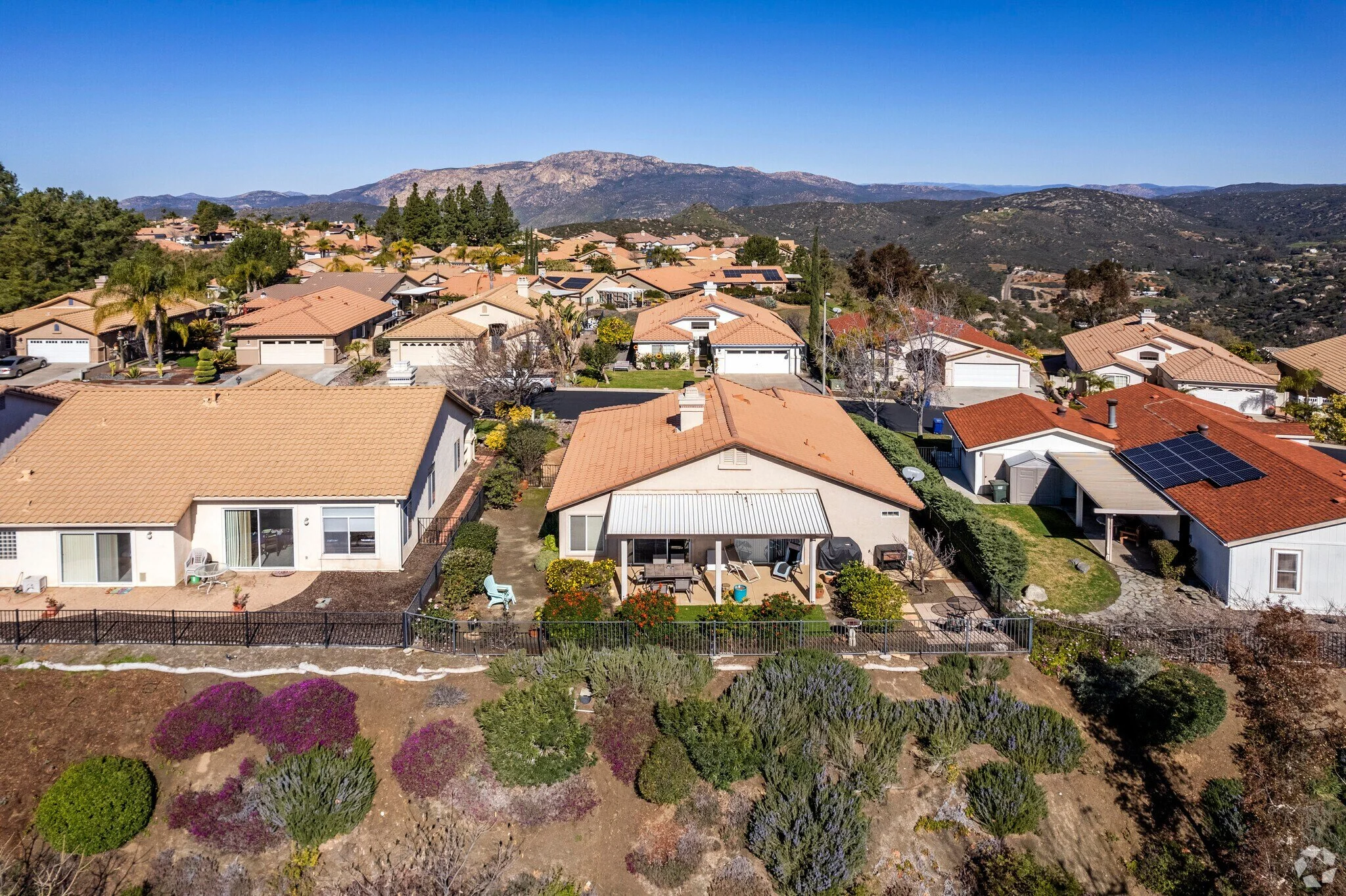
A neighborhood in Alpine. Photo: David Swanson/Coldwell Banker West
Insurance for Good: Are your hazard inspections free, and how can residents request one? Where does your department get funding for these?
Fire Marshal Jason McBroom: Home ignition zone assessments for Alpine residents are no cost, funded through the benefit fee residents already pay via their property taxes. Residents can request one at any time throughout the year, and I encourage them to take advantage of it. They can also send me photos as they complete mitigation work so I can update their report and go back to their insurer for a rerate.
Insurance for Good: If Alpine's approach is helping individual homeowners, what would it take for other fire departments to adopt and scale a similar program?
Fire Marshal Jason McBroom: Defensible space enforcement is fairly cut and dry, so most agencies are aligned there. Zone Zero is where things get complicated, because agencies are choosing different paths—some have adopted language moving toward compliance but are still in a multi-year education phase. Others have moved straight to enforcement. The bigger question every agency has to answer is: at what point do you move from education to enforcement? How many more fires, how much more loss of structures and life, before agencies decide they can do better?
Insurance for Good: There's been a lot of discussion about Zone Zero and defensible space. How is defensible space defined locally in Alpine?
Fire Marshal Jason McBroom: In Alpine, it's defined as a noncombustible zone: no combustible materials within the first five feet horizontally from the exterior wall face or the projection of decks and patios. That means no potted plants, no mulch, no compost, no bark, no in-ground plants of any kind, no trees, and no wood fencing directly attached to the home.
Insurance for Good: What happens if a property owner doesn't comply with defensible space requirements?
Fire Marshal Jason McBroom: If a homeowner requests an inspection and a deficiency is found, they get a 30-day notice to comply. So far I haven't had a homeowner tell me they've never heard of Zone Zero—insurance companies have done a good job putting it in renewal notices and mailers. I also show an IBHS wildfire video of ember casting, which tends to make the risk very real for people. No one in Alpine has refused to comply yet, so we haven't had to reach forced abatement.
Insurance for Good: What are the main barriers preventing fire departments from scaling this type of homeowner-insurance support today?
Fire Marshal Jason McBroom: Staffing and funding. A lot of agencies don't have the staff to go out and do these inspections, and they don't have a cost-recovery mechanism the way our property-tax-funded benefit fee allows. Others are simply waiting to see what direction CAL FIRE and pending state legislation take before committing resources.
Insurance for Good: How important is a standardized inspection form or digital system so results can be consistently documented and shared with homeowners and insurers? Have you used any of the new technology platforms for home assessment?
Fire Marshal Jason McBroom: Very important—and it's evolving quickly. The state just signed Assembly Bill 1964, which moves us toward a standardized document for home hardening, so agencies from the State Fire Marshal's Office down to the smallest local district can capture the same metadata and share data more consistently. I don't think every agency in the state will end up on one single software platform before 2030, but as long as we're capturing the same underlying data, sharing it with a central clearinghouse through CAL FIRE and, eventually, Sacramento is a strong step forward.
Insurance for Good: Did you expect, when you started working in fire, that you would also end up with an insurance side job? As we think about scaling this kind of homeowner-insurance engagement across the admitted market, do you think what you're doing fits well within the fire department's role, or is this more of an emergency stopgap?
Fire Marshal Jason McBroom: I did not think I would ever have to become as fluent in Title 10 insurance code as I have. So yes, there was a knee-jerk reaction—the insurance market kind of exploded, and everyone got very panicky between 2015 and 2020. The writing was clearly on the wall, so I started paying closer attention to what legislators were preparing to introduce: going to Sacramento, sitting in code committee hearings, writing our county fire code and local ordinance, and helping other fire agencies draft similar language so we could get ahead of what we knew was coming in the next three years, rather than waiting for legislation to pass and losing that time. That's how, in 2020, we built Zone Zero requirements into new construction through our county fire code and ordinances, ahead of what we knew Safer from Wildfires was going to require around exterior wall finish, roofing materials, and windows.
“The real question is how we work with insurance companies so we’re pulling in the same direction instead of opposite ones.”
That pushed us into being proactive as a community risk reduction agency, which is where we should be. Fire suppression and fire control are reactive by nature. But we must do the groundwork. It’s central to our mission to make homes and communities more fire resilient. We have to do that without overstepping our legislative authority, but when you look at 20 years of drought and fires that used to burn 100 acres now burning 100,000 acres overnight—the Camp Fire, the Paradise Fire, the Tubbs Fire, the Woolsey Fire—you realize we're no longer fighting a normal fire regime, we're fighting catastrophic wildfires, and it isn't going to get better on its own.
Insurance companies reacted to that reality, and it exposed a real misalignment: Our building and fire codes are not in step with our insurance code. We're completely out of sync. We have to change that philosophy and make sure all of those titles are working toward the same goal—save lives, protect property, preserve the environment. It doesn't matter which agency's patch you wear; the mission is aligned across the state. The real question is how we work with insurance companies so we're pulling in the same direction instead of opposite ones.